Hammersmith Bridge Bill Rises Over £50 Million
Dispute continues over who is paying for stabilisation and restoration
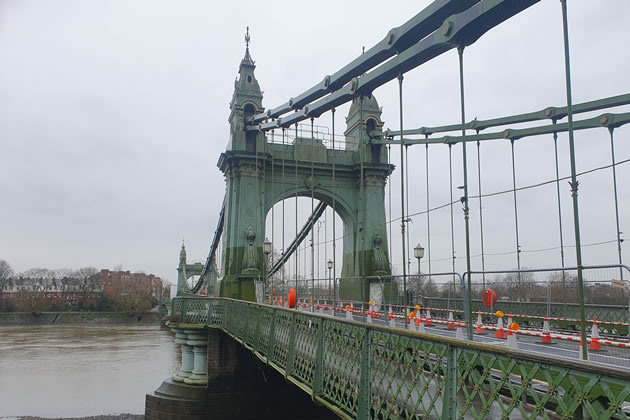
Most of the money has been spent by Hammersmith & Fulham Council
February 6, 2026
More than £50 million has been spent on Hammersmith Bridge by the local council since its partial closure seven years ago, new data reveals.
Hammersmith and Fulham Council, which owns the Grade II*-listed crossing linking the borough with Barnes, has spent significant sums ensuring it remains stable and safe while also preparing it to be restored.
The structure was closed to motor vehicles in 2019 and temporarily to all users the following year after micro-fractures were discovered in its pedestals.
It is currently available for use by pedestrians, cyclists and river traffic, though cars and other vehicles continue to be banned.
Its full restoration has however proven a sticking point. Under a 2021 funding settlement the previous Government struck with Transport for London (TfL), it was stated the local authority would pay a third of the total cost.
TfL and the Department for Transport (DfT) are to pick up another third each, with the total cost estimated to be more than £250m.
Hammersmith and Fulham Council has described the division of costs as an “unprecedented move”, with the bill traditionally paid by the DfT or regional government.
It has said to fund its share a toll would be required.
The council first submitted its business case outlining plans to restore and reopen the bridge to the previous Government in December 2022, and formally in March 2023. It is still awaiting approval.
In its latest Four Year Capital Programme, covering 2026 to 2030, Hammersmith and Fulham has revealed it has spent ?54m on the bridge as of last October.
The expenditure is made up by £37m on the crossing’s stabilisation and £17m on pre-restoration works.
It adds that the DfT has so far contributed £13m to the overall spend and TfL £2.9m, with the council claiming it is owed a further £20.2m from the two parties.
The DfT has disputed this point, telling the LDRS the agreement to split project costs was only applicable to the stabilisation and strengthening phases of engineering works.
A spokesperson said: “The repair and maintenance of Hammersmith Bridge is the responsibility of London Borough of Hammersmith and Fulham.
“We have already provided £17m, to keep the bridge open for walking and cycling, and will continue to work closely with the council and Transport for London on this.”
A TfL spokesperson said: “We have been supporting the London Borough of Hammersmith and Fulham, who are the owners and highway authority for the bridge, for a number of years.
“We have contributed ?3m towards stabilisation works and have also spent £16.7m on assessments, feasibility, inspections and surveys, designs and other matters.
“We continue to work with the borough, the Department for Transport and others to agree the right solution, as well as to agree how any future works to the bridge might be funded.”
A spokesperson for Hammersmith and Fulham Council said: “Hammersmith Bridge, built in 1887, is one of the world’s oldest suspension bridges which is why it is also one of Britain’s most expensive to repair.
“Following the submission of our bid last year, we are currently waiting to hear whether the Grade II*-listed bridge has been allocated money in the new £1 billion Structures Fund for transport infrastructure including bridges, tunnels and roads.”
Several alternative designs have been suggested for the bridge since its partial closure.
These include a pitch by architect studio Sybarite and engineering firm Buro Happold for two curved roads to be built alongside the crossing for use by motor vehicles.
The council’s opposition Conservative group has also suggested a new military-style crossing be constructed to enable the bridge to be repaired.
Ben Lynch - Local Democracy Reporter