Local Hospitals Push Ahead With Green Energy Overhaul
Emissions at Charing Cross already down by over a quarter last year
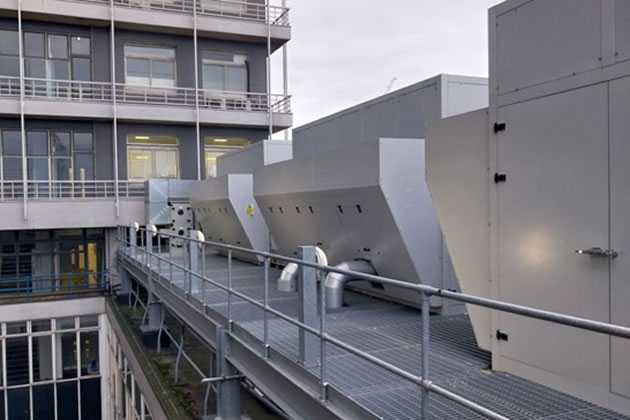
Green energy equipment on the roof of the hospital. Picture: Imperial College Healthcare NHS Trust
December 1, 2025
Imperial College Healthcare NHS Trust has announced a major new phase of its multi-year programme to cut the environmental impact of powering its hospitals including Charing Cross and Hammersmith, with £47.4 million to be invested over the next two years in modernising energy systems across its estate.
The new funding, secured from the Public Sector Decarbonisation Scheme (PSDS) and NHS England, forms part of a £120 million programme launched in 2021. Once complete, the Trust expects to reduce greenhouse gas emissions from heating, cooling and powering its buildings by 43% compared with 2020/21 levels — a saving of more than 20,000 tonnes of CO₂e a year. That is equivalent to the annual energy use of over 8,000 UK homes and puts the Trust firmly on track to meet NHS England’s 2032 target of a 47% reduction in directly controlled emissions.
Recent data shows the benefits are already being felt: emissions at Charing Cross Hospital fell by 27% between 2023/24 and 2024/25 following the first phase of upgrades.
The latest round of investment will fund:
- Two additional heat pumps at Charing Cross Hospital, along with improved insulation and cooling systems.
- New heat pumps and the first rooftop solar panels at Hammersmith Hospital.
- LED lighting upgrades and enhanced gas and electricity controls across all Trust sites
Much of the Trust’s estate is over a century old, with some buildings dating back 170 years. Ageing infrastructure and obsolete gas-powered heating systems have made large-scale upgrades essential to improve energy resilience and reduce the risk of system failures. Since 2020/21, over £110 million in external funding has been secured to overhaul the estate, supplemented by £9.48 million of Trust capital.
Most of the decarbonisation work so far has focused on Charing Cross and Hammersmith, where upgraded infrastructure can be integrated into long-term redevelopment plans combining major refurbishment and new construction. By contrast, St Mary’s Hospital is due for a complete rebuild, limiting the scope for major short-term decarbonisation work. However, it will still gain from Trust-wide improvements such as LED lighting and upgraded building-management systems.
Professor Bob Klaber, the Trust’s director of strategy, research and innovation and net-zero lead, said the organisation remained committed to cutting its environmental impact.
“We are one of the biggest NHS trusts in the country and are strongly committed to reducing our impact on the environment through a range of schemes linked to our Green Plan,” he said. “Decarbonising our hospital buildings is a key part of this.”
Eric Munro, director of estates and facilities, emphasised both the complexity and the benefits of the programme.
“Many of our buildings are rapidly ageing and reliant on outdated, inefficient gas boilers,” he said. “But the benefits are clear – reducing our environmental impact, improving resilience and lowering the risk of estate failures.”
<r Munro highlighted the “remarkable” 27.5% fall in emissions at Charing Cross last year, calling it “an extraordinary achievement” and crediting colleagues and partners including Dalkia and CBRE.
He also noted that while the Government has said it will not commit further money to the PSDS, all current awards remain fully funded.
Charing Cross Hospital has been the flagship site for the Trust’s decarbonisation efforts. A £26.9 million PSDS award in 2021 funded the first major installation of heat pumps to replace ageing gas boilers and steam systems in the main tower block. The project involved:
- 15 new plant rooms
- 8km of piping installed around the tower
- Refurbishment of 24 air-handling units
- More than 70 crane lifts
- Construction work paused temporarily to protect nesting peregrine falcons on the tower
Further phases of heat-pump installation are planned, which are expected to deliver even larger reductions in emissions.
Since 2021 the Trust has received:
- £26.9m for heat pumps at Charing Cross (2021)
- £22.9m for de-steam works and heat pumps at Hammersmith, plus another at Charing Cross (2022)
- £41.8m for heat pumps and solar PV at Hammersmith, and additional heat pumps at Charing Cross (2024)
- £12.88m from NHS England for LED lighting and building-management upgrades (2025)
- £6.43m for a cascaded heat pump at Charing Cross (2025)
In total, £110.9 million in funding has been secured, with a £9.48 million contribution from the Trust.
With work continuing through 2026/27, Imperial College Healthcare says it will keep pursuing investment and partnerships to maintain momentum towards a greener, more resilient estate.
Like Reading Articles Like This? Help Us Produce More This site remains committed to providing local community news and public interest journalism. Articles such as the one above are integral to what we do. We aim to feature as much as possible on local societies, charities based in the area, fundraising efforts by residents, community-based initiatives and even helping people find missing pets. We’ve always done that and won’t be changing, in fact we’d like to do more. However, the readership that these stories generates is often below that needed to cover the cost of producing them. Our financial resources are limited and the local media environment is intensely competitive so there is a constraint on what we can do. We are therefore asking our readers to consider offering financial support to these efforts. Any money given will help support community and public interest news and the expansion of our coverage in this area. A suggested monthly payment is £8 but we would be grateful for any amount for instance if you think this site offers the equivalent value of a subscription to a daily printed newspaper you may wish to consider £20 per month. If neither of these amounts is suitable for you then contact info@neighbournet.com and we can set up an alternative. All payments are made through a secure web site. One-off donations are also appreciated. Choose The Amount You Wish To Contribute. If you do support us in this way we’d be interested to hear what kind of articles you would like to see more of on the site – send your suggestions to the editor. For businesses we offer the chance to be a corporate sponsor of community content on the site. For £30 plus VAT per month you will be the designated sponsor of at least one article a month with your logo appearing if supplied. If there is a specific community group or initiative you’d like to support we can make sure your sponsorship is featured on related content for a one off payment of £50 plus VAT. All payments are made through a secure web site. |