Survey Reveals Fatigue Crisis Among London Bus Drivers
Unite says that it raises safety concerns for passengers and pedestrians
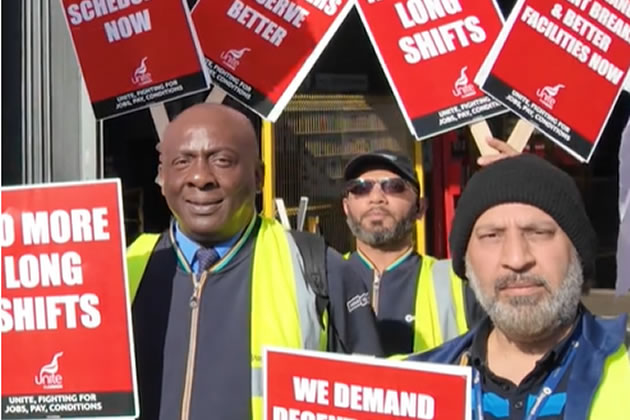
Bus drivers protesting about long shifts. Picture: Unite the Union
April 17, 2026
A major new survey by Unite has exposed the scale of fatigue among London’s bus drivers, raising concerns about the safety of workers, passengers and pedestrians across the capital. The union gathered more than 2,000 responses from drivers at the end of 2025 and found that tiredness behind the wheel is now widespread, routine and, in many cases, severe.
More than a third of drivers said they felt sleepy while driving two or three times a week, and almost a quarter reported the same problem at least once a week. Almost half admitted they had experienced a “close call” in the past year because of fatigue. Unite says these findings point to a system in which long shifts, inadequate breaks and unrealistic schedules are pushing drivers to the limits of their concentration.
Drivers described working patterns that would be unthinkable in many other safety-critical industries. It is common, the survey found, for drivers to work thirteen consecutive days with only a single day off, and twelve-hour shifts remain a regular feature of the job. Many said they struggled with concentration lapses and “micro-sleeps” — brief, involuntary moments of unconsciousness that can last seconds but have potentially catastrophic consequences when operating a bus in London traffic. Others reported chronic pain, cardiovascular problems, stress and anxiety linked to the demands of the job.
Despite the risks, most drivers do not feel able to report fatigue to their employers. Eighty-three per cent said they feared disciplinary action, loss of earnings or the removal of rest-day working if they admitted they were too tired to drive. Unite argues that this culture of silence is preventing operators and Transport for London from understanding the true scale of the problem.
Scheduling pressures are also contributing to the crisis. When London introduced widespread 20mph limits in 2020, bus timetables were not significantly adjusted. Two-thirds of drivers said they frequently do not have enough running time to complete their routes, and more than half said they were forced to work overtime or finish late several times a week as a result. Unite says these pressures have intensified since Loughborough University’s 2019 study into driver fatigue, with a third of drivers now reporting that the situation has become “much worse”.
Unite general secretary Sharon Graham said the findings show a system that is failing both workers and the public. She described the results as “damning”, arguing that the combination of inadequate rest, poor scheduling and forced overtime has created an unacceptable level of risk. “No worker should be overworked to the point where they are falling asleep at the wheel,” she said. “TfL and bus operators are not treating this crisis with the seriousness it deserves.”
The union has launched a new campaign, Fight Fatigue Now, calling on TfL and bus companies to overhaul their approach. Unite wants fatigue management to be embedded into the bus network, including an end to disciplinary action for drivers who report tiredness and better protections for those working in extreme heat without air-conditioning. It is also calling for consistent scheduling, including a minimum of twelve hours between duties and more predictable start times, as well as improved rest, toilet and welfare facilities. More than half of drivers surveyed said the facilities available to them were poor, and some reported still taking breaks at the roadside.
Unite regional officer Nadine Edwards said the situation has deteriorated because previous attempts to address fatigue have been “pitiful”. She argued that meaningful change will only come from listening to drivers themselves and working with the union to implement reforms. Without this, she warned, the risks to workers and the public will continue.
Drivers who took part in the survey described the personal toll of fatigue. One said they had experienced “heavy eyelids and loss of concentration” that led to missed stops, wrong turns and even driving through a red light. Another said that after working five, six or seven consecutive days, often with more than forty hours completed in the first four, they felt as though they were “on autopilot”, not fully alert and at risk of making serious mistakes.
Lorna Murphy, TfL’s Director of Buses, said: "Bus drivers play a vital role in keeping London moving, and the welfare of both our drivers and customers is paramount.
"Working closely with Unite, bus operators and drivers, we set and enforce high standards so that drivers are supported by safe vehicles, fair work schedules and the facilities they need to do their jobs effectively.
“We have long standing programmes in place covering education, health and wellbeing, rest facilities, workplace culture and clear welfare policies, with a strong focus on understanding and tackling fatigue. This includes improving how we gather and analyse data on when fatigue occurs, alongside the recent introduction of fatigue detection technology, so the right, evidence based interventions can be put in place.
“We have not seen Unite’s survey, but we welcome all input on fatigue and will continue working with Unite to address it.
"Any concerns raised by drivers are always taken seriously and fully investigated, and operators should never take action against anyone raising welfare or safety issues."
Like Reading Articles Like This? Help Us Produce More This site remains committed to providing local community news and public interest journalism. Articles such as the one above are integral to what we do. We aim to feature as much as possible on local societies, charities based in the area, fundraising efforts by residents, community-based initiatives and even helping people find missing pets. We've always done that and won't be changing, in fact we'd like to do more. However, the readership that these stories generates is often below that needed to cover the cost of producing them. Our financial resources are limited and the local media environment is intensely competitive so there is a constraint on what we can do. We are therefore asking our readers to consider offering financial support to these efforts. Any money given will help support community and public interest news and the expansion of our coverage in this area. A suggested monthly payment is £8 but we would be grateful for any amount for instance if you think this site offers the equivalent value of a subscription to a daily printed newspaper you may wish to consider £20 per month. If neither of these amounts is suitable for you then contact info@neighbournet.com and we can set up an alternative. All payments are made through a secure web site. One-off donations are also appreciated. Choose The Amount You Wish To Contribute. If you do support us in this way we'd be interested to hear what kind of articles you would like to see more of on the site – send your suggestions to the editor. For businesses we offer the chance to be a corporate sponsor of community content on the site. For £30 plus VAT per month you will be the designated sponsor of at least one article a month with your logo appearing if supplied. If there is a specific community group or initiative you'd like to support we can make sure your sponsorship is featured on related content for a one off payment of £50 plus VAT. All payments are made through a secure web site. |